
Six & 7/8
Circa 1998, my friend Dan moved to Cincinnati from Northwest Ohio. Yes, another Napoleon alum in the ‘Nati. He and his brother had a mortgage brokerage company. It was the beginning of the mortgage refinancing boom, spurred by rates that were dropping over a 40 year period, and loose lending standards.
30 year mortgage rates dropped under 7% in the fall of 1998, a key psychological and numerical mark. As recently as the fall of 1994, the 30-year rate was over 9%. When rates dropped under 7%, millions of homeowners holding loans at 8.5% to 10%+ rates were able to unlock massive monthly savings of $150 to $300+ per month.
This downward shift was driven by two key forces:
Global Macro Instability: The 1997 Asian Financial Crisis and the 1998 Russian debt default prompted global capital to flee risky international assets for safety in U.S. Treasury bonds. As demand for Treasuries surged, bond prices rose and yields fell—dragging mortgage rates down with them.
Tech Innovation: Mortgage giants Fannie Mae and Freddie Mac rolled out automated underwriting systems. This shortened loan approval times from months to days, lowered administrative fees, and popularized low-cost refinance packages.
Dan is nothing if not one heckuva salesperson. Before long, he refinanced the mortgage on my first home on Montana Ave and had me telling all my P&G friends about his great rates. “Six and ⅞” became our rallying cry.
Slashed monthly payments were the primary driver, but homeowners could also take cash out for renovations, stock market investments, or debt payoff—or swap a 30-year loan for a 15-year term to build equity faster. This initial refi wave was a huge net positive for the economy. It wasn’t until the early 2000s that exotic products like “option ARMs” crept in, setting the stage for the 2007–2009 housing crisis.
—-----------------------------------------------------------------------
A Quick Refresher on Bonds & Mortgage Rates
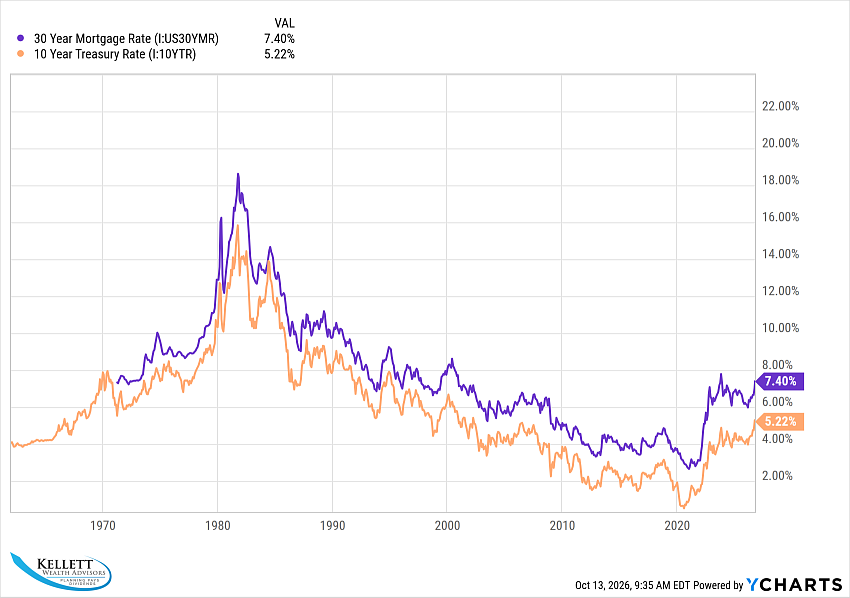
The 30-year mortgage rate closely tracks the 10-year Treasury bond yield. Why 10 years instead of 30? Because the average homeowner refinances, moves, or pays off their loan within ~10 years.
To understand where rates are going, we have to look at how bonds work:
You lend the money (the principal or face value) to a government or corporation.
They pay you interest (the coupon rate) on a regular schedule.
They return your full principal on a specific date in the future (the maturity date).
The Golden Rule of Fixed Income: Bond prices and interest yields move in opposite directions. When bond prices go down, yields go up.
From its peak in 1981, the yield on the 10-year bond (and by extension, 30-year mortgage rates) fell steadily for four decades, hitting historic lows around 2021. Beginning in 2021, and accelerating in the last year, bond interest rates have risen steadily. You can see in the chart below that the yield on a 10 year Treasury is now over 5% from a low of 0.6% in 2021. This has pushed mortgage rates up to 7.4% from a low of 2.7%.
Why Have Yields Risen Since 2021?
The primary catalyst was post-COVID inflation, which hit 40-year highs in 2022. To combat rising prices, the Federal Reserve launched an aggressive rate-hiking campaign, raising its benchmark rate from near zero to over 5%.
While inflation has cooled from its peak, four structural forces continue to keep yields elevated:
Persistent Growth & Inflation Concerns: Strong employment, resilient earnings, and lingering supply issues keep baseline inflation above the Fed’s 2% target.
Surging Government Debt Supply: Massive spending has pushed U.S. national debt past record levels. To fund this deficit, the Treasury is issuing record volumes of new bonds, flooding the market and pushing yields higher to attract buyers.
Quantitative Tightening (QT): Instead of buying Treasuries as it did during the pandemic, the Fed is letting hundreds of billions in bonds roll off its balance sheet, removing a key buyer.
Higher Term Premium: Investors now demand higher compensation (yield) for holding long-term debt due to rising global debt burdens and fiscal policy uncertainty.
What Does This Mean for Investors?
When yields rise, existing bond prices drop—hitting long-term bonds hardest. However, once yields stabilize, new bonds offer much higher income.
It’s a classic mixed bag: short-term price pain for longer-term income gain. For now, we favor shorter-term bonds (maturities under 2 years), which are yielding between 4.0% and 4.8% with minimal price volatility.
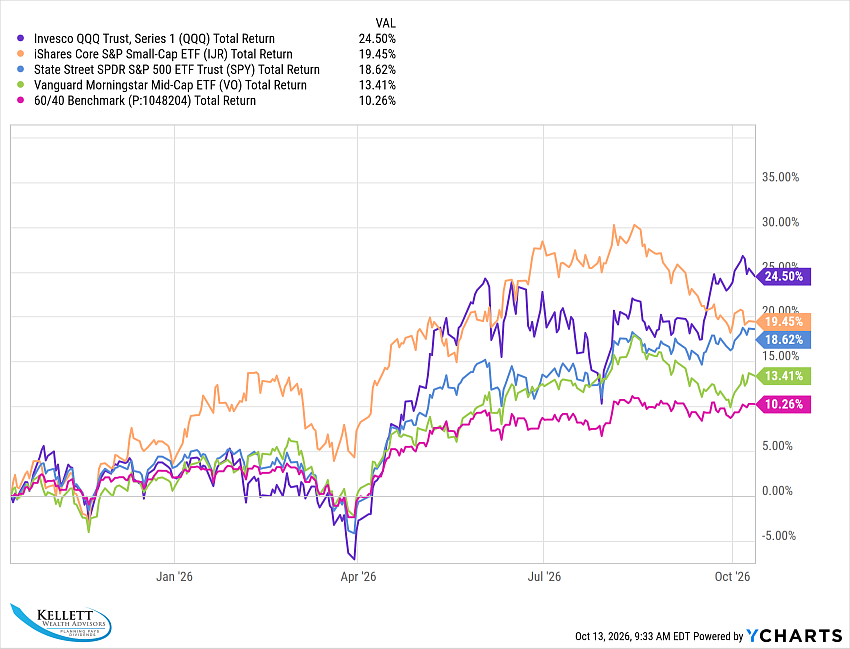
What about the stock market? Rapidly rising yields often trigger stock pullbacks as investors swap riskier equities for guaranteed bond yields. But so far, corporate earnings and tech/AI momentum—alongside low unemployment (4.2%)—have kept stocks resilient. Over the past year, everything from small caps to technology (and even classic 60/40 portfolios) is up over 10%.
Summary:
Pundits on social media regularly declare the demise of the economy when yields rise. While pullbacks or bear markets are always possible after an 18-year run, long-term investors know the rule: when in doubt, zoom out.
Today’s yields feel high because we became accustomed to the historic lows of 2021. In reality, current rates are much closer to historical norms. If yields come down even slightly from here, we might just hear that mortgage rate rallying cry again: “Six and ⅞!”
Jared
What’s Your Financial Story?
Brian Kellett, brian@kellettwealth.com. Phone 513-312-6067
Dave Bodnar, david@kellettwealth.com. Phone 513-258-6973
Jared Kline, jared@kellettwealth.com. Phone 513-768-2238
Andrew Finlay, andrew@kellettwealth.com.
The YCharts charts are my own.
I used Google Gemini for many of the details of the railroad build-out and the cyclical economy graphs.
Kellett Wealth Advisors LLC is a Registered Investment Adviser. Advisory services are only offered to clients or prospective clients where Kellett Wealth Advisors LLC and its representatives are properly licensed or exempt from licensure. This website is solely for informational purposes. Past performance is no guarantee of future returns. Investing involves risk and possible loss of principal capital. No advice may be rendered by Kellett Wealth Advisors LLC unless a client service agreement is in place.