
Of Silicon and Steel
Announcement
We are excited to announce a new member of your Kellett Wealth team. Andrew Finlay is joining us on July 1. Andrew is a CFP® who has been at Plante Moran in Columbus. Andrew graduated from the University of Dayton with a degree in Finance. He remains involved in the UD community and works with Cincinnati area alumni. At Plante Moran, Andrew worked with individuals and families on their planning needs. We added Andrew to the team because more of you are entrusting more of your money with us. It’s a good time to invest in our future with you. We also thought it was a good time for us to, um, get younger. 😂 You can expect to see Andrew in meetings and on phone calls as we immerse him in your plans.

I was back in Napoleon on the first day of summer, June 21, to celebrate my dad’s 92nd birthday. He told the story of his great grandfather, John, who lived into his 90s. While the discussion was about the longevity in our family - great grandpa John lived to 92, grandpa Barney was just shy of 91 when he died, and my dad is 92 - it got me thinking about the era John lived in…… John was born in 1852 and came to the US during the railroad build-out era, eventually settling in Posen, MI. The railroad build out boom occurred primarily in the 1860’s and 1870’s. This led to the Panic of 1873, a severe economic downturn caused by the rolling over of the narrow railroad investment. The infrastructure was revolutionary, but it took another 15 to 20 years for populations to migrate, towns to form, and the rest of the economy to broaden out and utilize those tracks profitably.
To that very point, my great grandpa would have been 41 in 1893 when the Alpena & Northern Railroad (which later became the Detroit & Mackinac Railway) blasted through the pine forests, opening a line through Presque Isle County. In June 1894, a physical railroad depot was built right in Posen, MI. The railroad allowed massive lumber companies to move cut trees out of the region without relying on ships on Lake Huron or grueling stagecoach trails. The railroad is the exact reason John lived in Posen. In 1893, right as the railroad infrastructure was being laid, a Chicago real estate developer hired Polish salesmen to sell plots of land to Polish immigrants. The railroad made these remote timber plots accessible and viable for settlement. Shortly thereafter, in 1896, my grandpa Barney was born. He later joined hands with Clara Hoppe from another Polish family, and the Kline family would continue on.
—-----------------------------------------------------------------------
As we celebrate America’s 250th birthday, one thing is clear. America is doing what America does best: building the future at an unimaginable, reckless and triumphant scale. The press often compares the current AI boom to the internet age. But that misses the sheer physical scale of what is happening. This isn’t the Internet boom; this is the Railroad Era reborn. As in that era, American growth is narrow, propelled by a frantic race to lay down the AI infrastructure. Just as the government and private titans poured everything into the steel rails, today’s titans are pouring everything into silicon and data centers.
In the 1860s and 1870s, a massive chunk of capital was flowing into physical iron tracks, building locomotives, and blasting through mountains. Timber, steel and the creative financing to make it happen were all the rage. Today, instead of laying tracks from Omaha to Sacramento or Detroit to Mackinac, we are laying fiber-optic cables and stacking Nvidia processing units in massive data centers in Ohio, Virginia and Texas. The railroads are a better analogy than the Internet because the boom is intensely physical. AI doesn’t live in a cloud; it lives in massive concrete structures that require gigawatts of power and millions of gallons of water for cooling.
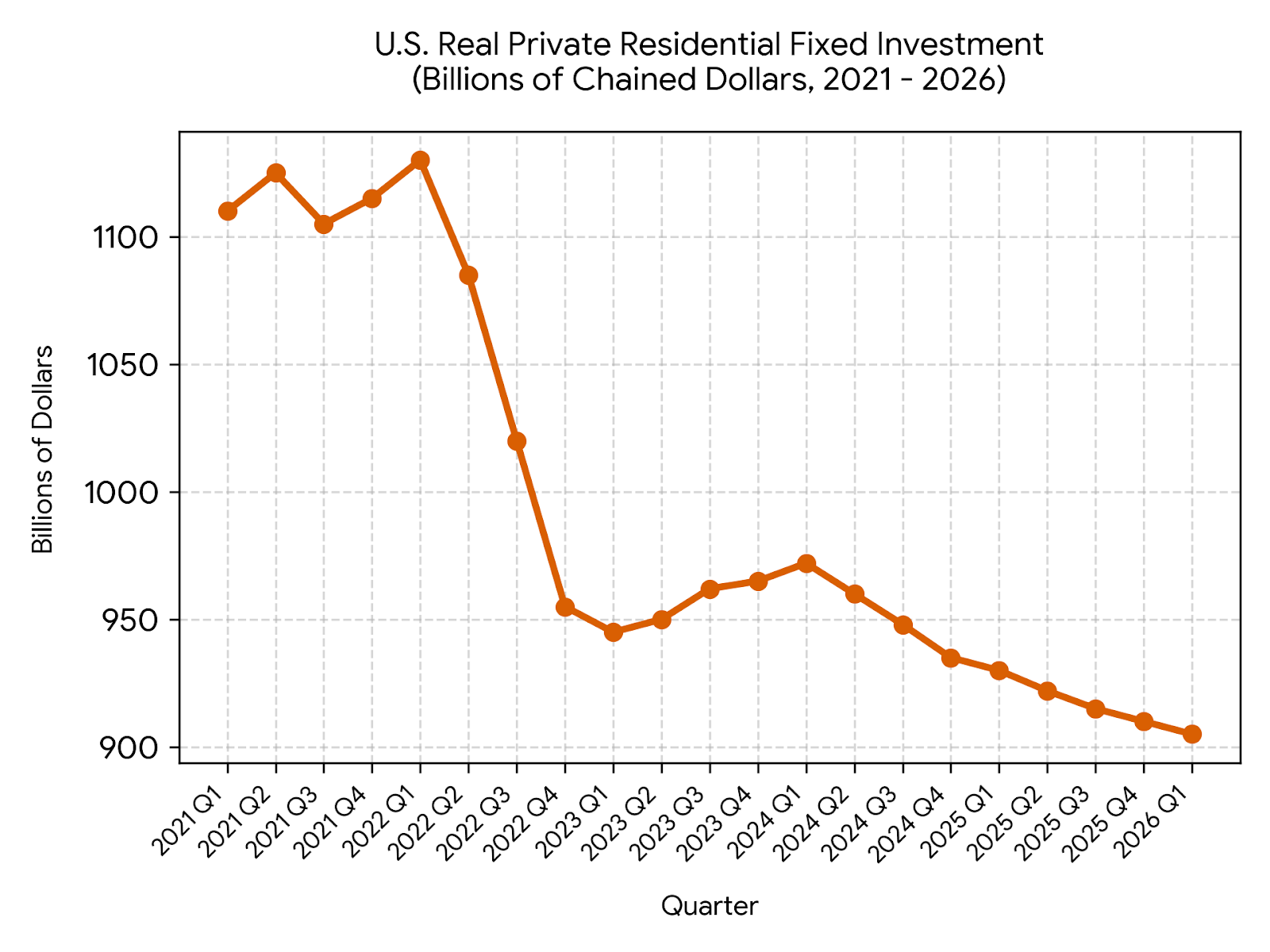
When we look at the economy, most of the growth is coming from the AI boom. If you look at one of the main areas of the cyclical economy, housing, you will see that investment in this area has been in decline for two years. The graph below captures spending on home construction, major remodeling, and brokers’ commissions:
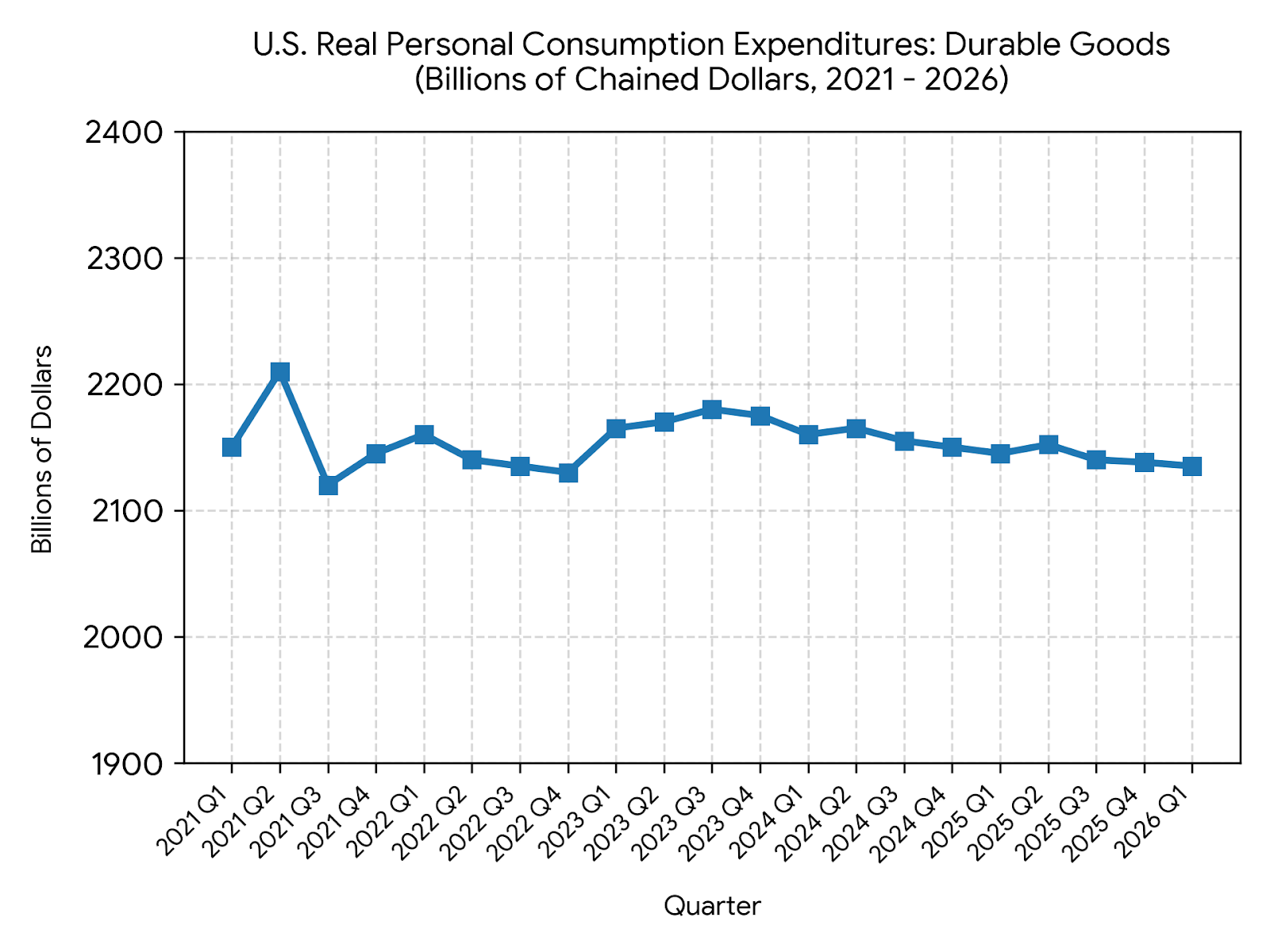
To add to the picture, consider the next chart which shows spending on “durable goods”. These are long-lasting items like cars, appliances, furniture, and electronics. You can see that this spending has flat-lined. To be clear, these numbers aren’t bad. The 2021 numbers are inflated by the Covid bump. But they certainly have plateaued and continue to show little signs of growth:
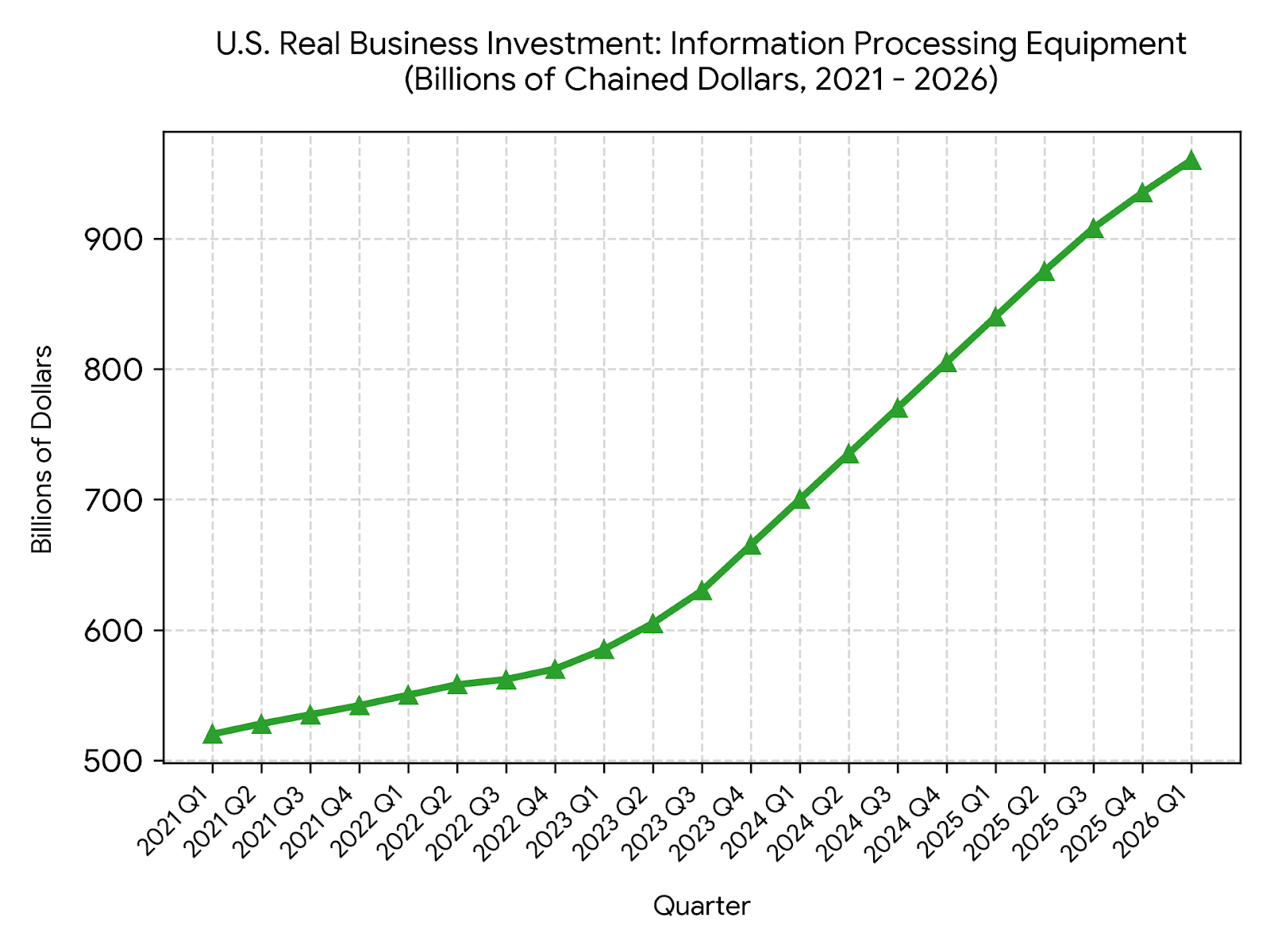
Which leads to the final chart related to the economy. Since 2023, the AI boom has been in full force. The chart below shows what corporations are spending on semiconductors, servers, data center hardware, and communication equipment. In late 2022, generative AI models exploded onto the scene, and a corporate arms race ensued. The big companies like Microsoft, Google, Amazon and Meta (parent company of Facebook) and thousands of smaller companies increased spending from $520 billion (2021-22) to $665 billion (2023-24). In the first quarter of 2026, this spending exploded to $960 billion.
Impact on the stock market:
The major indices have posted strong year-to-date returns with the S&P 500 up over 7% and the NASDAQ 100 up 15%. The rally is being driven by blockbuster corporate earnings growth. First quarter earnings grew in the 18-28% range (depending on the specific financial model used). To put a bit more emphasis on the narrowness of the earnings growth, tech giants averaged 60% earnings growth. The IT sector logged 50% growth, Communication Services (including Google & Mega) logged 53% growth. On the other hand, consumer staples (P&G, Kimberly Clark, Clorox) grew 6%, while health care and energy both contracted.
Outlook:
Many of the large Wall Street firms have increased their year-end targets on the S&P 500. If inflation cools and the Fed is able to lower interest rates, lower mortgage rates would likely revive the home-building industry. Lower borrowing costs would re-ignite durable goods consumption. At some point, the “track laying” of the AI build-out will subside. It will be interesting to see how the investment turns into profitability for these huge companies. The Microsoft’s, Google’s and Meta’s have been cash flow machines. They’ve temporarily turned those cash flows into AI investments. The future will tell us how well those investments lead to profits. Relatedly, the customers of Microsoft, Google, Oracle and others, will attempt to harness that AI power to improve efficiency. Time will tell whether that leads to improvements to the bottom line.
Summary:
Right now, the AI boom looks narrow, isolated to tech giants and massive data centers while housing and durable goods wait for their turn. But remember 1893. The Alpena & Northern Railroad was just a physical track blasted through remote timberland. To the casual observer then, it was a speculative gamble. To my great-grandfather John, it was the gateway to a future. It brought the settlers, built the towns, and allowed families like mine to take root.
As we celebrate America’s 250th birthday, we are witnessing the exact same playbook. The infrastructure being built in Ohio, Virginia, and Texas today is the foundation for tomorrow's broader economic expansion. Happy 4th everyone!
Jared
What’s Your Financial Story?
Brian Kellett, brian@kellettwealth.com. Phone 513-312-6067
Dave Bodnar, david@kellettwealth.com. Phone 513-258-6973
Jared Kline, jared@kellettwealth.com. Phone 513-768-2238
Andrew Finlay, andrew@kellettwealth.com.
The YCharts charts are my own.
I used Google Gemini for many of the details of the railroad build-out and the cyclical economy graphs.
Kellett Wealth Advisors LLC is a Registered Investment Adviser. Advisory services are only offered to clients or prospective clients where Kellett Wealth Advisors LLC and its representatives are properly licensed or exempt from licensure. This website is solely for informational purposes. Past performance is no guarantee of future returns. Investing involves risk and possible loss of principal capital. No advice may be rendered by Kellett Wealth Advisors LLC unless a client service agreement is in place.